Talley Your Adventure – The Blog

Adventure Awaits!

At Talley Your Adventure, we don’t just plan luxury and culturally rich travel experiences—we live and breathe them. Our blog, travelingtalleys.blog, is where we share the real stories behind our adventures: kayaking alongside glaciers in Alaska, exploring temples in Japan, chasing waterfalls in Iceland, and wandering through storybook towns in Germany. If it’s unforgettable, chances are we’ve done it—or we’re planning it next. Impact-Site-Verification: 8a69d429-4a55-4b53-b8f6-72c437661af5

Nicolette brings deep experience in travel and heritage. With a Master’s in Public History, she’s worked as a Supervisory Park Ranger, Revenue Manager, and Program Analyst across multiple national parks for over a decade. Her career has taken her from managing interpretive boat tours in Alaska’s wild backcountry to overseeing large-scale visitor service projects with million-dollar budgets. And yes—she’s also a licensed 100-Ton Inland Master Boat Captain who’s led cultural and ecological tours from riverboats to remote beaches.

Clinton’s travel roots run just as deep. He’s worked in logistics and operations for the National Park Service and was a key member of the hospitality team aboard National Geographic Lindblad Expeditions. From managing guest services on remote international voyages to coordinating facility software systems stateside, he knows what it takes to deliver seamless, high-end travel experiences—even in the most unpredictable places.

Together, we created Talley Your Adventure to bring our experience, passion, and attention to detail to your travel planning. Whether it’s a fully curated group trip or a personalized vacation built just for you, we combine expert-level service with insider know-how—so you can focus on the magic of the journey.

Want us to help you on your next adventure? Head over to www.talleyyouradventure.com!

Sakura Blooms – Inuyama, Japan

  • One of the best camping experiences that Clinton and I had was when we stayed at Coral Pink Sand Dunes. This was back in 2011, but it is memerable for the wonderful location – beautiful and remote – and for the awesome dunes that we were able to walk around on during our trip. I was even able to see the Coral Pink Sand Dunes tiger beetle in action!

    Coral Pink Sand Dunes State Park was only a side trip back in 2011. Today it is between Page and Kanab and is an easy day drive on U.S. Highway 89. The park is in southwestern Utah and features Navajo Sandstone – just in a different form! The dunes are formed as the Navajo Sandstone slowly erods by high winds. Upon arrival, visitors will notice a deck that is easily accessible from the parking lot for a quick view of the dunes. We opted to walk out on the dunes themselves, with many other visitors following suit. There were a few ATV’s out and about driving among the dunes. It looked like a lot of fun!

    During our second visit we included a short hike for the #TalleyYourMiles campaign! The dunes are hard to walk on if you don’t have the right gear since it is literally soft sand that was blown through a notch between the Moquith and Moccasin Mountains that surround the park. The dunes are estimated to be between 10,000 and 15,000 years old. That’s a lot of erosion! The hills of sand can move as much as 50 feet per year.

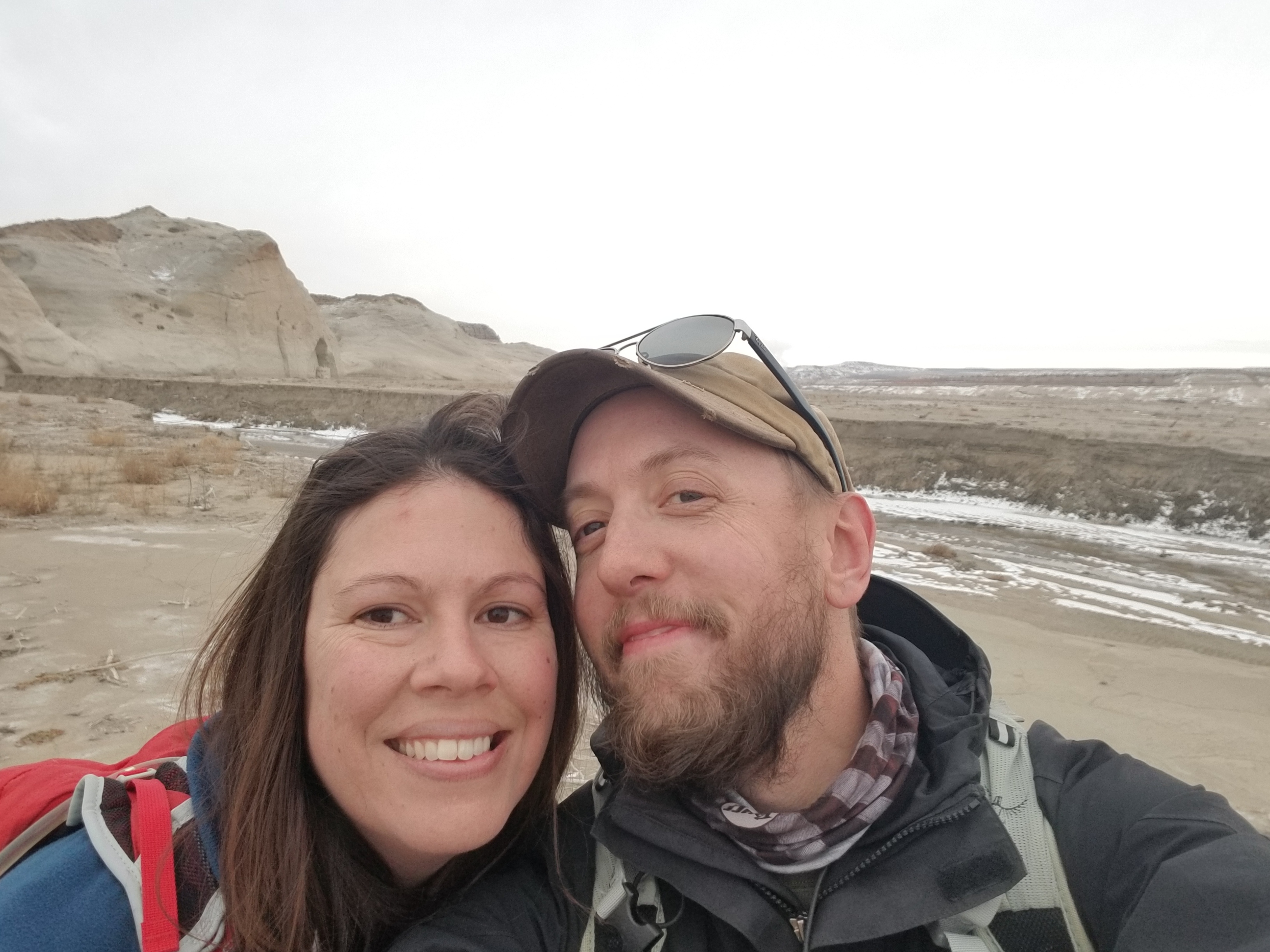
    The park is open year round and we’ve visited both over the summer and during the winter. While it was cold it was a beautiful day when we visited recently. Wear sunglasses as even in the winter the glare on the dunes from the sun can be intense! There is an $8 daily entrance fee and to camp is $20, but the price is well worth the experience. Camping, hiking, off-road vehicle driving, and photography describe the many activities that can take place while visiting this gorgeous park. It was established as a state park in 1963 and includes 3,370 acres – including a conservation are of 265 acres.

    Visiting the park can easily be done as a half day or full day experience and even the drive in and around the area is beautiful and worth the adventure. Take the long way around if you are ever in the area and add this state park as a destination!

  • Clinton at the Grand Canyon, 2011

    It’s probably common knowledge that the Grand Canyon is magnificent. You see pictures all the time when just Googling “the west”, and many beautifully written articles almost make you feel like you’re standing right on the edge.

    But I promise you that none of that compares to actually seeing or being at the Grand Canyon in person. Close your eyes and listen to the wind build at the canyon bottom. Feel the sunlight on your face as you gaze out over an indescribable landscape. Watch the clouds play a game with the sunlight as they glide over the canyon walls. It truly is remarkable. The first time that I saw the Grand Canyon I had spent the night in my cold vehicle with Clinton because there was no availability in the campsites and no openings in the hotels. We actually drove into the Grand Canyon at about 4 in the morning once we decided that we would keep driving instead of stopping. We may have been young and dumb then, but when we walked out over the canyon near the Desert View Watchtower and saw the sun rise over the canyon it was all worth it. The area holds a special place to me because of this experience. I was tired, cold, and hungry but I didn’t care because the canyon was so intensely gorgeous nothing could upset me.

    We are fortunate that we live in such a great location for a quick day trip to the Grand Canyon. Since moving to Page we’ve been almost once a month. I have personally been to the Grand Canyon in a variety of situations, from work based training that included hiking with my brother, to quick sunset picture trips with Clinton. The Desert View Watchtower is only an hour and a half from our home! The north rim is equally close but since it is winter the roads are closed. We are so excited to have such a beautiful park so close!

    The Grand Canyon was carved out of the Colorado River and has a depth of over a mile. Gazing out on the exposed rok you can see the many layers that make up the ecological story of the Grand Canyon. The Colorado River is powerful but looking at the many cuts in the landscape that we now know were created by the Colorado River it is amazing to think about because of how wide and deep the canyon actually is. The canyon is also part of the Kaibab National Forest, Grand Canyon-Parashant National Monument, the Hualapai Indian Reservation, ahd Havasupai Indian Reservation, and Navajo Nation.

    2019

    The Desert View Watchtown is a 70 foot high stone building that was designed by American architect Mary Colter. Colter designed many other buildings in Grand Canyon as an employee of the Fred Harvey Company. The tower is much larger than what it was designed to resemble – an ancient Pueblo Peoples watchtower. Today the bottom floor is contains a gift shop and the top floors host an observatory deck. It is a grand view over the canyon that you won’t see elsewhere.

    There is so much to explore at the Grand Canyon that it is hard to describe in only one post. We will continue to visit many of the same parks throughout our time living in Page but will focus on different topics of interest each time. Hopefully you’ll learn something new with each post! Stay tuned for our next adventure!

  • During our time in Baltimore Clinton and I were able to visit many fascinating areas and wonderful historic places in the city. Most of them were within easy reach, such as the Historic Ships in Baltimore. I’ve written already about Constellation and Torsk but there are actually four ships that you can visit. If you are able to take the whole day we recommend seeing all four, but it does take time and be aware that these are historic ships. If air conditioning wasn’t the latest technology in their time, don’t expect it in your time. If you take an Uber like we did, just tell them to park near the Baltimore World Trade Center/Aquarium. There is a turn-around that makes it easy for them to exit, and it is right there for you to easily walk to and start your adventure!

    The Coast Guard Cutter Taney was build in the Philadelphia Havy Yard on May 1, 1935 when her keel was laid. Commissioned on Ocotber 24, 1936 Taney spent her first port in Honolulu, Hawaii to intercept opium smugglers and carry out search and rescue missions. After an armament upgrade in 1940 and 1941, Taney was assigned to the US Navy’s Destroyer Division 80. She was tied up at Pier 6 when the Japanese flew over the city, but she was able to engage the planes and immediately commence anti-submarine duties after the attack subsided. In 1943, Taney was transferred to the Atlantic Theater as the command vessel for six convoys of troop and supply ships.

    After World War II Taney was moved to Alameda California where she participated and carried out decades of weather patrols, fisheries patrols, and rescue missions. During the Korean War Taney received additional weapons and carried our plane-guard duties off Midway and in Alaska. Taney served in the Vietnam War by participating in Operation Market Time, where she intercepted illegal arms and supplies and provided medical assistance. After the war she would see similar tours of duty with more weather patrols and “hurricane hunting” with a new Doppler weather radar installation. Completing the Coast Guard’s last ocean weather patrol in September 1977, Taney had the distinction of closing out Ocean Weather Station HOTEL.

    Carrying out search and rescue duties, fisheries patrols, and drug interceptions was a major life for Taney and is evident with her last missions. During the period of 1977 – 1986 she made 11 major seizures of illegal drugs including the largest bust in US History. In December 1986 she was given to the city of Baltimore in preservation of history and culture, and to serve as a memorial after 50 years of continuous service to the United States.

    Taney was a large ship that was a lot of fun walking through. It’s set up for easy navigation through the ship with tons of information along the way. Another fun tour was of Chesapeake, a Lightship completed in 1930 and used in the US Lighthouse Service. A lightship is as ship that literally acts like a lighthouse. They are used in deep water or areas that are unsuitable for lighthouse construction. If you’ve ever read about life in a lighthouse can you image if the house was a ship?

    Built in South Carolina, the vessel featured the latest technology and updates including an efficient diesel-electric power-plant. Besides all her fancy technology, the ship was equipped with two 5,000 pound mushroom anchors that were designed to hold the ship in rough weather.

    Like most ship accomodations the Lighship was designed for efficiency, but not necessarily crew satisfaction. A crew of 16 with several away on shore leave at any given time included crew accomodations of an electrically powered galley and regrigerator unit. Surprisingly to us today this was a major advancement for the 1930s. The strenght of Chesapeake and her crew was evident many times, but more so on two separate occasions where the Lightship rode out hurricanes so powerful that the crew had to drop the spare anchor after the chair broke, and run full ahead into the wind in order to remain stationary. Lightship 116’s final duty was at the approaches to the Delaware Bay until replaced by a automated light buoy in 1970. Since 1982 the ship has been part of the Historic Ships in Baltimore.

    What I like best about Baltimore is not only her diverse, fantastic history but the amazing opportunities you have to learn about that history while living or visiting the city. Clinton and I rarely drove downtown on weekends, instead relying on Uber. We loved walking places if we could, and truly enjoyed the ease of getting around the heart of the city. If you plan to head to Baltimore in the future make sure to spend some time learning about the city and her history!